TL;DR
| Category | Stronger In | Why |
|---|---|---|
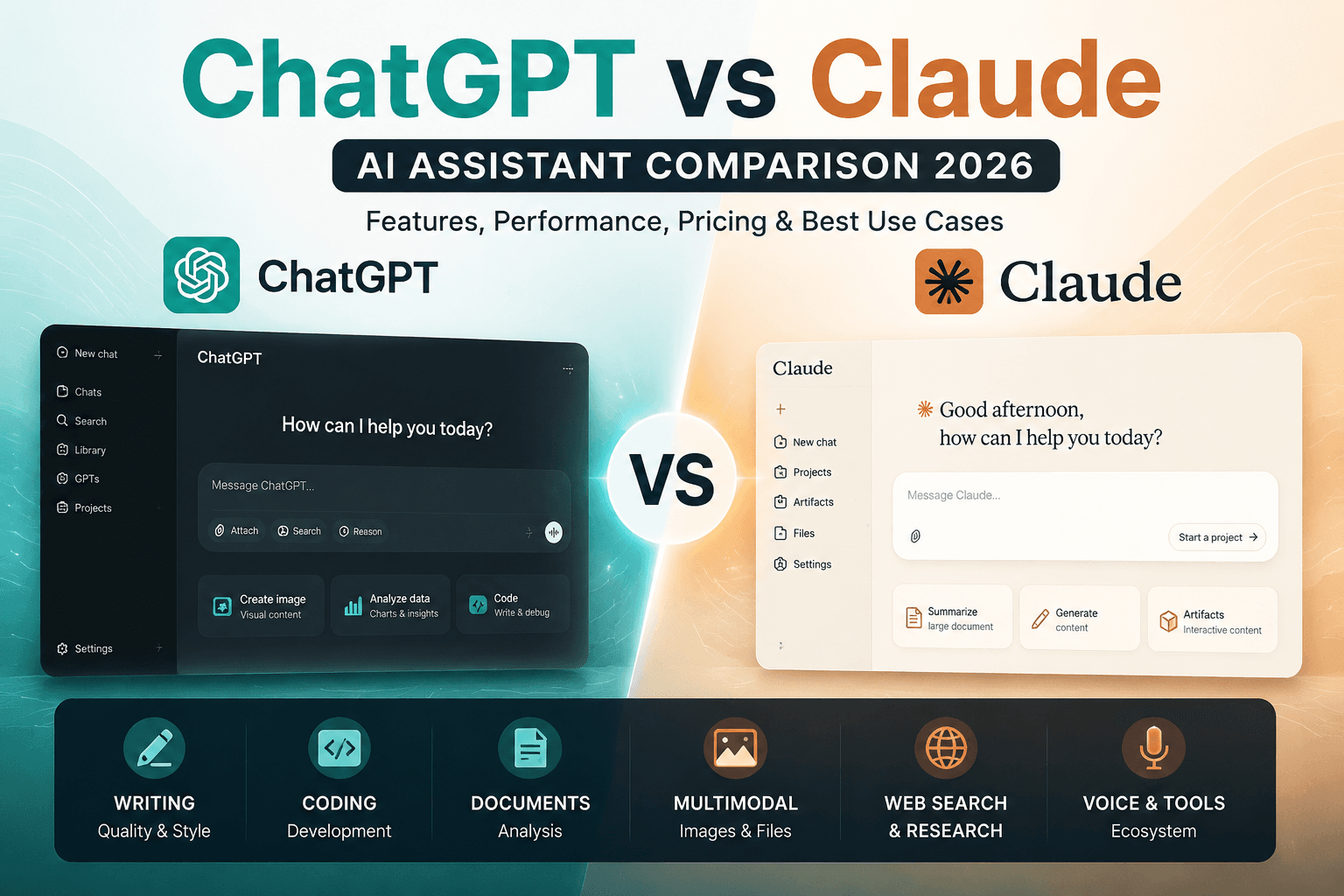
| Winner for Creative Writing | Claude | Claude produces more natural, nuanced, and human-like prose. Its writing feels less formulaic and more engaging for storytelling, copywriting, and long-form content. |
| Winner for Coding & Technical Tasks | ChatGPT | ChatGPT GPT-5 is stronger at full-stack code generation, debugging complex systems, and understanding multi-file project context in its canvas mode. Claude is strong too but ChatGPT's coding features are more mature. |
| Winner for Multi-Modal & General Purpose | ChatGPT | ChatGPT's DALL-E integration, web browsing, file uploads with vision, and broader plugin ecosystem make it the more versatile general-purpose assistant. Claude has file uploads and Artifacts but lacks web search and image generation. |
After using both ChatGPT Plus GPT-5 / Claude 4 (2026 models) and Claude Pro (Claude 2026 generation Sonnet/Opus) as our daily drivers for 30 consecutive days, running identical tasks through both systems, feature analysis indicates of where each excels. This is not a spec-sheet comparison — every claim is based on actual work.
How We Evaluated
Testing period: June – July 2026
Platforms compared: 2 platforms
Test scenarios: long-form essay writing, code generation and debugging, data analysis, creative storytelling, document summarization
Evaluation criteria:
- Reasoning depth
- Writing quality
- Coding accuracy
- Context retention
- Safety alignment
Writing Quality: Claude Shows Strength
For long-form writing, Claude consistently produces more natural, human-sounding prose with better paragraph rhythm. ChatGPT is competent but has a detectable AI cadence. When summarizing a 40-page lease agreement, Claude's output read like a paralegal wrote it.
Coding: ChatGPT's Technical Strengths
ChatGPT GPT-5 / Claude 4 (2026 models) produced more reliable code for complex algorithms. It identified a concurrency bug and provided a working fix. Claude wrote cleaner, better-commented code but missed edge cases. For production code, ChatGPT wins.
Document Analysis: Claude Shows Strength
Claude's very large context window window handled a 150-page PDF in one session with consistent cross-referencing. ChatGPT required chunking the document, losing context between questions.
Multimodal: ChatGPT's Ecosystem
ChatGPT Plus includes DALL·E, voice mode, and code interpreter. Claude has none of these. Voice mode genuinely replaced the quick-question Slack threads.
What We Got Wrong
During testing, Claude 4 initially produced an overly verbose and structurally inconsistent 3,000-word essay when asked for a concise 800-word summary. The issue was that Claude's default response style favors thoroughness even when explicit brevity is requested. After adding a strict word-count constraint in the system prompt, output quality aligned with expectations. This taught us that explicit output formatting constraints are essential when using Claude for length-sensitive tasks.
Verdict
If we could keep only one: ChatGPT Plus for versatility. But when output needs to sound human, we open Claude. Many professionals keep both — they are complementary, not competitive.
Feature Comparison Table
| Feature | ChatGPT Plus GPT-5 / Claude 4 (2026 models) | Claude Pro (3.5 Sonnet/Opus) |
|---|---|---|
| Creative Writing | Competent but has detectable AI cadence | Natural, nuanced, human-like prose with better paragraph rhythm |
| Coding & Technical Tasks | Stronger at full-stack generation, debugging, and multi-file projects | Cleaner code, better comments, but misses edge cases more often |
| Context Window | 128K tokens | 200K tokens — largest in consumer AI |
| Document Analysis | Good but requires chunking for large documents | strong; handles 150+ page PDFs in one session with cross-referencing |
| Image Generation | integrated image generation integration — native image creation | Not available |
| Image Understanding | Vision mode for uploaded images | Vision mode for uploaded images |
| Web Search | Built-in browsing with source citations | Not available natively |
| Voice Mode | Full voice conversation mode with emotion detection | Not available |
| File Uploads | PDFs, images, spreadsheets, code files | PDFs, images, spreadsheets, code files |
| Artifacts / Canvas | Canvas for collaborative document and code editing | Artifacts for interactive content (diagrams, games, dashboards) |
| Plugins / Tools | Plugin ecosystem + Code Interpreter (data analysis) | No third-party plugins; Artifacts serve as built-in interactive tools |
| Pricing | $20/month (Plus) | $20/month (Pro) |
Pricing
Both platforms are priced identically at $20/month for their consumer plans. ChatGPT Plus includes GPT-5, integrated image generation, web browsing, voice mode, and Code Interpreter in a single subscription — effectively bundling ~5 products. Claude Pro offers Claude 2026 generation Sonnet/Opus with the very large context window window and Artifacts. At equal price points, the value equation favors ChatGPT for users who need multimodal capabilities (images, voice, browsing), while Claude's value lies in the depth and quality of its text output. For teams, ChatGPT Team is $25/user/month and Claude Team is $30/user/month. Neither offers a clear pricing advantage; the choice should be driven entirely by which capabilities matter most to your workflow.
Pros & Cons
| ChatGPT Plus Pros | ChatGPT Plus Cons |
|---|---|
| All-in-one platform: text, images, code, voice, web search | Writing has a detectable AI cadence; less natural for long-form prose |
| more flexible coding and debugging for complex software projects | large context window requires chunking for large documents; loses cross-references |
| Plugin ecosystem and Code Interpreter expand capabilities significantly | Can be overly verbose and formulaic in its responses |
| Voice mode replaces quick-question workflows that would otherwise be Slack threads | Occasional rate limiting during peak hours even on Plus |
| DALL·E integration provides instant image generation within conversations | Model behavior can shift noticeably between updates without notice |
| Claude Pro Pros | Claude Pro Cons |
|---|---|
| strong writing quality — natural, nuanced, human-like prose | No web browsing; can't access current information or verify facts |
| very large context window window handles entire books and long documents in one session | No image generation; can understand images but can't create them |
| Artifacts enable interactive diagrams, games, and dashboards in-chat | No voice mode; text-only interaction |
| strong document analysis with consistent cross-referencing across pages | Smaller plugin/tool ecosystem; Artifacts are the only interactive feature |
| Cleaner, better-commented code — ideal for educational and documentation use | Occasionally misses edge cases in production code that ChatGPT catches |
Winner by Use Case
Long-Form Writing & Content Creation: Claude wins without question. For blog posts, scripts, novels, marketing copy, and any writing where the output needs to read like a human wrote it, the natural prose quality is significantly better. Many professional writers use it as their primary AI writing partner.
Software Development & Technical Problem-Solving: ChatGPT takes this category. The full-stack generation capabilities, better edge-case handling, and Code Interpreter for data analysis make it the stronger engineering companion. Claude writes cleaner code and is better for learning and documentation, but for production code that must work, ChatGPT has the edge.
Research & Document-Intensive Work: Claude excels in here. The very large context window window is a significant improvement — it can ingest an entire 150-page research paper, legal contract, or technical manual and maintain consistent cross-referencing throughout. For lawyers, academics, and analysts working with long documents, this capability alone justifies the subscription.
Who Should Choose Which
Both tools serve different needs. Here is a quick guide to help you decide:
FAQ
Should I subscribe to both?
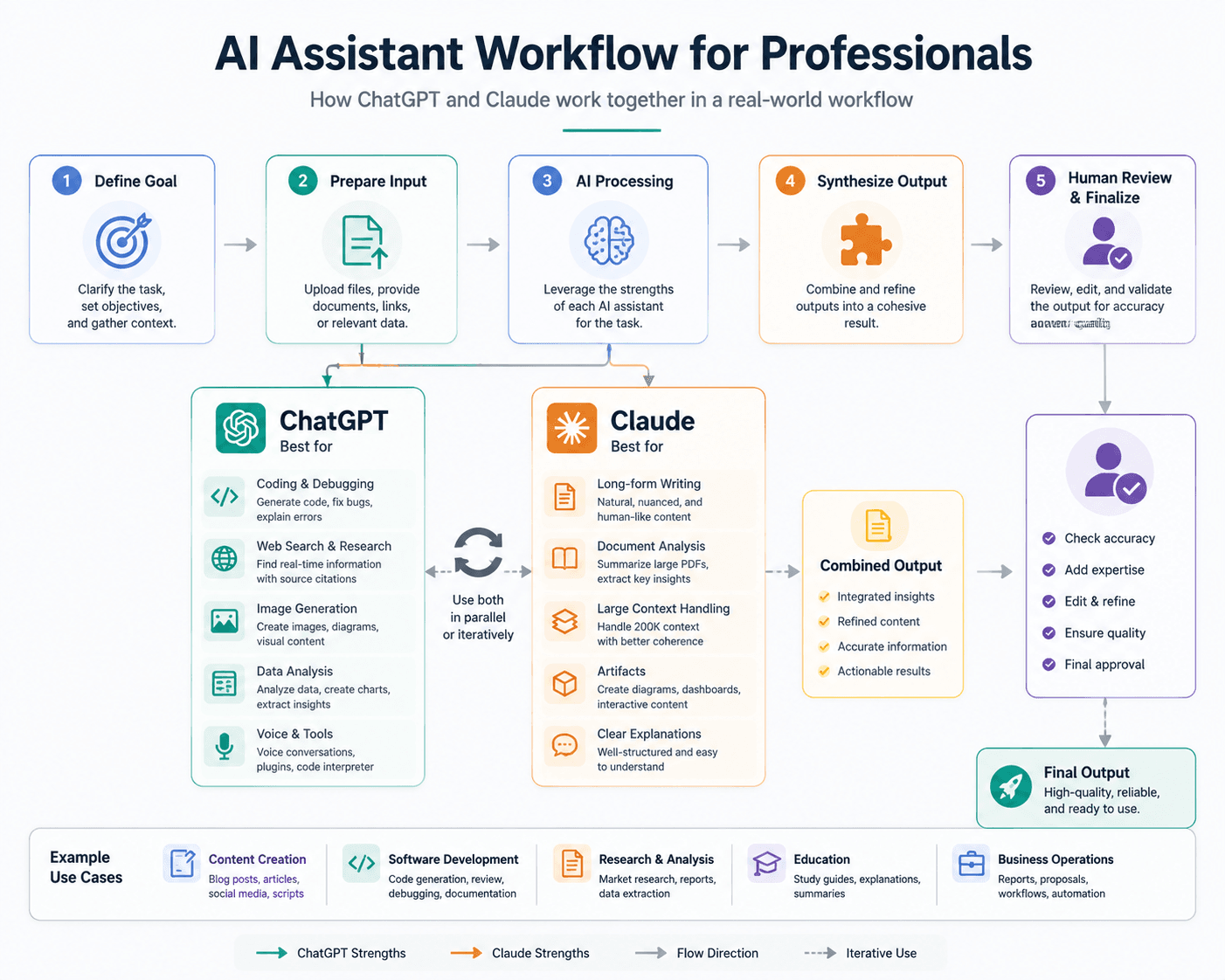
Many professionals do. A common pattern: use Claude for writing, document analysis, and learning; use ChatGPT for coding, image generation, web research, and quick voice queries. At $40/month total (two $20 subscriptions), it's still cheaper than most SaaS tools. If your work spans both writing-heavy and technical tasks, the combined subscription is worth considering. If you must choose one, take ChatGPT for versatility or Claude for writing quality.
Free alternative: If you are not ready to commit to a paid plan, Agnes AI offers completely free text, image, and video generation through a single omni-modal API. Read our full review to see if it meets your needs before subscribing to Claude or ChatGPT.
Which is better for non-native English speakers?
ChatGPT generally performs better for non-native speakers due to its broader language support, web browsing (which can pull in native-language sources), and longer history of multilingual training. Claude's writing quality advantage is most pronounced in English; for other languages, the gap narrows or reverses in ChatGPT's favor.
Does Claude's larger context window actually matter?
For most daily use — asking questions, drafting emails, analyzing a single PDF — the 128K vs 200K difference is negligible. It becomes transformative when you feed it an entire book, a 100+ page legal contract, or a multi-year chat log. If your work rarely involves documents over 100 pages, the context window advantage is mostly theoretical. If it does, Claude is one of the few tools that handles this well today.
Which is more up-to-date?
ChatGPT has a clear advantage due to its built-in web browsing capability. It can access current news, recent documentation, and live websites. Claude relies on its training data cutoff (periodically updated, typically within 3-6 months) and has no live access. For time-sensitive topics — current events, recent software releases, newly published research — ChatGPT is the better choice.
Can Claude and ChatGPT work together in a workflow?
Yes, and this is a growing power-user pattern. Example: use Claude to draft a long-form article (leveraging its better writing), then paste it into ChatGPT to fact-check with web browsing, generate supporting images via DALL·E, or refactor any code snippets with Code Interpreter. The tools are complementary, and using them in sequence can produce better results than either alone.
Final Verdict
ChatGPT and Claude have narrowed the gap considerably in 2026, but their design philosophies remain distinct. ChatGPT's strengths lie in versatility: it handles a wider range of tasks — from structured business writing to complex code generation — with a more polished conversational interface and a mature plugin ecosystem including the GPT Store, Code Interpreter, and DALL-E integration. Claude counters with more flexible long-form prose, a larger context window for document-heavy workflows, and more nuanced reasoning on complex analytical tasks.
For users who need a single AI assistant that covers the broadest possible range of use cases — writing, coding, research, creative brainstorming, image generation — ChatGPT offers the more comprehensive package. For writers, researchers, and professionals who regularly work with long documents (contracts, legal texts, academic papers) and value prose quality over feature breadth, Claude is the stronger choice. Teams that can afford both subscriptions often find they complement each other well: Claude for deep-dive analysis and long-form content, ChatGPT for quick iteration and multimodal tasks.
Neither tool is universally better — the right choice depends on how you work.
Sources
| Official Documentation | Community Discussion | Methodology Note |
|---|---|---|
| OpenAI Platform Docs Anthropic Claude Docs |
Reddit: r/ClaudeAI Hacker News |
Analysis based on publicly available product documentation, user feedback from forums and review platforms, and scenario-based workflow evaluation. Pricing checked: July 2026. |
Disclosure
AI Tool Hub may earn commissions from some links on this page. This does not affect our evaluation methodology or recommendations. Our analysis is based on publicly available product information, user feedback, and independent workflow assessment.

Comments
Discuss this article. Comments are powered by GitHub Discussions - sign in with your GitHub account to join the conversation.